Hemp Dispensary in Cary, NC: Your Guide to Nature’s Supreme Wellness
June 13, 2026
THCa Flower in NC: What It Is, Is It Legal, and Where to Buy It
June 13, 2026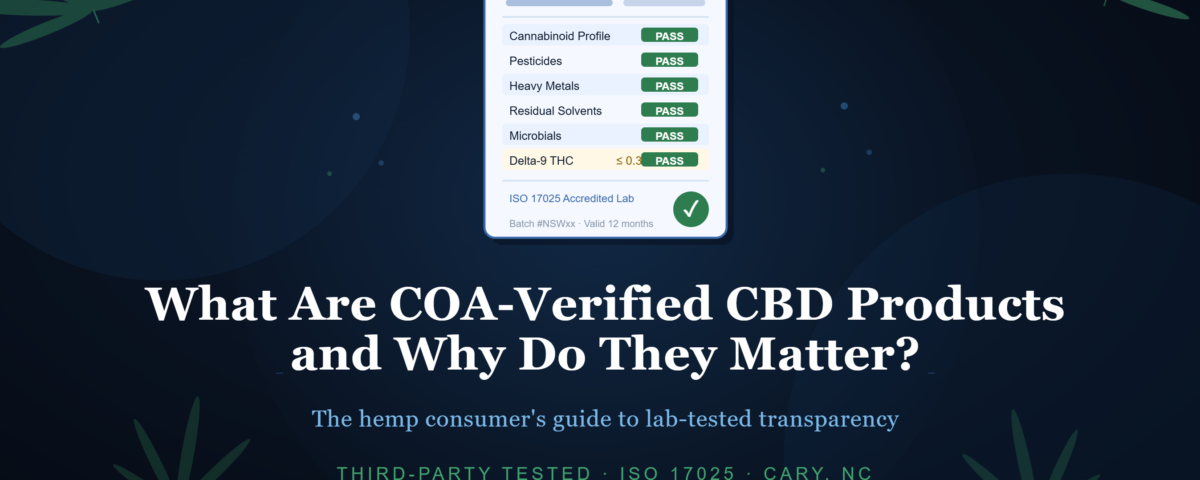
Walk into any gas station, grocery store, or smoke shop in North Carolina, and you’ll find CBD products staring back at you from the shelf. Gummies in bright packaging. Tinctures with sleek labels. Impressive-sounding claims about potency, purity, and results.
But here’s the question no one asks loudly enough: how do you actually know what’s in them?
The CBD and hemp market is largely unregulated at the point of sale. The FDA does not pre-approve hemp products before they hit shelves. No agency is physically checking each batch before it reaches you. That means the responsibility for verification falls on two parties: the brand that makes the product, and the retailer who chooses to carry it.
A Certificate of Analysis (COA) is the document that bridges the gap. It’s the gold standard for CBD transparency, and understanding it is the single most important thing you can do as a hemp consumer.
What Is a Certificate of Analysis (COA)?
A Certificate of Analysis is a formal document issued by an independent, accredited laboratory that confirms the chemical composition of a hemp or CBD product. It tells you what’s actually in the product, not what the brand claims is in it.
The key word is independent. A COA is only credible if it comes from a third-party lab with no financial relationship to the brand being tested. An in-house lab, or a lab paid to produce favourable results, is not meaningful verification.
What a COA Tests For
Cannabinoid Profile: The full breakdown of cannabinoids present: CBD, Delta-9 THC, THCa, CBG, CBN, and others. This confirms that potency matches the label and that THC levels are within legal limits.
Pesticides: Hemp is a bioaccumulator, meaning it absorbs whatever is present in the soil and surrounding environment. A clean pesticide panel confirms the plant was grown without harmful chemical residues.
Heavy Metals: Lead, arsenic, mercury, and cadmium are among those tested. All should read ND (Not Detected) or below established safety thresholds.
Residual Solvents: Some extraction methods use chemical solvents. A COA confirms these have been fully removed from the final product.
Microbials: Mold, yeast, E. coli, and Salmonella testing ensures the product is safe for consumption.
Who Issues COAs?
Legitimate COAs come from ISO 17025-accredited laboratories a certification that confirms a lab meets internationally recognized standards for testing competence. This accreditation is what separates a trustworthy test result from a document that just looks official.
The lab name should be distinct from the brand name. If a company is testing its own products, the results mean nothing.
Why COA-Verified CBD Products Are Non-Negotiable
The Mislabeling Problem Is Real
Multiple independent studies have found significant discrepancies between what CBD product labels claim and what the products actually contain. Some products have been found to contain more THC than labelled, a potential legal and professional issue for consumers subject to drug testing. Others contain far less CBD than advertised, meaning customers are paying for a potency they’re not actually receiving.
Without a COA from an independent lab, you have no way to verify either of these things. You’re simply taking the brand’s word for it.
What COA Verification Protects You From
Buying COA-verified CBD products protects you from multiple real risks. It ensures you’re not consuming a product with illegal THC levels that could cause a positive drug test. It confirms you’re not being exposed to pesticides, heavy metals, or microbial contamination. And it verifies that the potency on the label reflects what’s actually in the product so you can dose consistently and trust the results.
Legal Compliance in North Carolina
North Carolina hemp law requires that products comply with the federal hemp framework: no more than 0.3% Delta-9 THC by dry weight. A COA is the proof of that compliance. When you buy from a retailer that carries only COA-verified products, you’re also protecting yourself from inadvertently purchasing something that falls outside legal limits.
How to Read a CBD Certificate of Analysis
COAs can look intimidating at first glance: columns of numbers, chemical names, and abbreviations. But once you know what to look for, reading one becomes straightforward.
Step 1: Confirm the Lab Is Independent
Find the lab name and look it up separately. Confirm it holds ISO 17025 accreditation. The lab’s name should not appear anywhere on the brand’s website as an internal resource. If you can’t verify the lab’s independence, the COA isn’t meaningful.
Step 2: Check the Cannabinoid Panel
This is the section that confirms potency. Find the CBD percentage or milligrams per serving and compare it to what’s printed on the product label. A discrepancy of more than 10-20% is a red flag. Then locate the Delta-9 THC reading; it must be 0.3% or below for legal hemp compliance.
If you’re looking for full-spectrum benefits, you’ll also want to see THCa, CBG, and CBN present in the profile. A product that claims to be full-spectrum but shows only CBD in the cannabinoid panel is likely mislabeled.
Step 3: Review the Contaminant Panels
Scan the pesticide, heavy metals, residual solvents, and microbials sections. For most contaminants, you want to see ND (Not Detected) or a PASS notation. A legitimate COA will list specific numbers, not just a generic ‘Pass’ for the entire panel. If a COA shows only pass/fail without actual detected values, ask for the full panel.
Step 4: Check the Batch Date and Batch Number
A COA should be no older than 12 months. Products change over time; formulations get updated, batches vary, and an outdated COA may not reflect what’s actually in the product you’re holding. The batch number on the COA should also match the batch number printed on the product’s packaging. A mismatch means the COA may have been prepared for a different batch.
COA Quick Reference: What to Look For
| What to Check | What You Want to See |
| Lab accreditation | ISO 17025 certified, independent lab |
| Delta-9 THC level | ≤0.3% (NC and federal compliance) |
| CBD potency | Matches label within ~10% |
| Pesticides | ND (Not Detected) or below action limits |
| Heavy metals | ND for lead, arsenic, mercury, cadmium |
| Microbials | No mold, E. coli, salmonella |
| COA date | Within the last 12 months |
| Batch number | Matches product packaging |
Nature’s Supreme Wellness COA Commitment
Every product carried at Nature’s Supreme Wellness, in-store and online, is third-party tested before it ever reaches a shelf. The full COA library is published and accessible to all customers on the Lab Reports page, because transparent CBD products are the only kind worth selling.
When you visit in store, any staff member can walk you through the COA for any product you’re considering. No hedging, no ‘we don’t have that,’ no vague reassurances. If a product doesn’t have an independent COA, it doesn’t make the cut.
This is the Nature’s Supreme Wellness standard and it’s the standard every hemp retailer should be held to.
Red Flags: When to Walk Away from a CBD Product
Now that you know what good looks like, here are the signs that a product or retailer isn’t worth your trust:
No COA available. If a brand can’t or won’t produce a Certificate of Analysis, that is a hard stop. No exceptions.
COA is from an in-house lab. Self-reported testing has no credibility. Look for a third-party ISO-accredited lab.
Batch number mismatch. If the COA batch number doesn’t match the packaging, you’re looking at test results for a different product.
COA older than 12 months. Outdated documentation doesn’t protect you from what’s in the current batch.
Only pass/fail results with no actual numbers. A real COA shows specific detected values, not just a generic pass notation. Ask for the full panel.
Staff can’t answer questions about lab testing. If the person selling you CBD doesn’t understand what a COA is, shop somewhere else.
The Bottom Line
A Certificate of Analysis isn’t bureaucratic paperwork; it’s the proof that a brand respects its customers enough to be held accountable. In an unregulated market, it’s one of the few tools consumers have to protect themselves.
Never buy CBD without one. And if the retailer you’re shopping at can’t produce lab results on demand, that tells you everything you need to know.
View our full COA library at naturessupremewellness.com/lab-reports
Questions about a product’s lab results? Visit us in Cary, NC; we’ll walk you through it.